Posted by Pamela on Friday, September 30th, 2011 , Posted in Blog, News , Comments Off

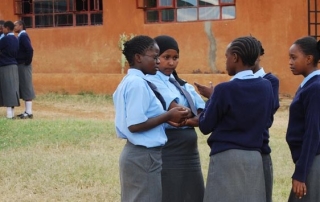
Daraja’s been out showing neighborhood schools what we’ve got once again! This week the girls competed in a mathematics contest with awesome results. And with midterms just a few weeks away, they’re studying hard and keeping up with their extracurricular activities as well.
Math competition – Last weekend, the keenest Daraja math students competed against three other schools in a local math contest. They performed extremely well, with Lilian taking the top spot in the Form 1 competition and Esther W., Mary K. and Mesret tying for third! Monicah, from Form 3, also came third in her competition.
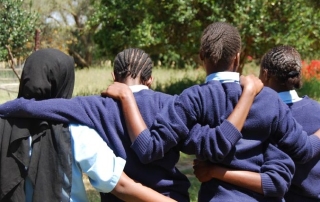
Way to go girls!
Maasai dance workshop – A group of Daraja girls led volunteers from Danish NGO ActionAid in some traditional songs and dances on Friday afternoon. Led by Form 3 students Mary P. and Tina, students paired with volunteers to help them with the words of the songs and the dance steps.
WISH – Continuing on the theme of leadership, Teacher Victoria spoke with the Form 3 girls about the legacy and work of Nobel laureate, Wangari Maathai, who passed away last weekend. Monicah read a short biography about Maathai and the Victoria discussed how her work started at the grassroots level but contributed enormously to Kenya and the world. She encouraged the girls to do small acts until they too can fill the shoes of a woman like Maathai.
The Form 2s continued working on their oral history project, which is scheduled to be finished at the end of term. The book the girls are writing will tell elders’ stories from their communities. And the Form 1s did skits on different types of choices: conditional, unconditional, unlimited, limited and no choice. Several of the skits focused on decisions the girls will face after high school – what to study at university, how they will fund future studies and what to do if they get stuck in a bad job.
Posted by Pamela on Wednesday, September 28th, 2011 , Posted in Blog, News , Comments Off

The challenge all the Daraja girls have in common is the financial struggle to get into high school. One Form 1 student had another challenge on top of that – epilepsy.
Before starting at Daraja, this student said that she used to have to miss school for several days at a time. She had headaches and seizures regularly, wasn’t able to travel alone and couldn’t sleep over with her friends. She was frightened to fall asleep, even at home, after having a seizure at night and biting her tongue and being unable to speak or eat for several days.
When it came time to apply to high school, at the age of 15, her aunt told her that since there was no money for school her education was up to her. She learned about Daraja, applied and was accepted. She was nervous about going to boarding school, afraid that she would have seizures at night.
Biology and chemistry teacher, Mercy
When she started classes in February, biology and chemistry teacher Mercy said she “could barely stay awake in class. And she just seemed so worried all the time.” Then one evening she had a seizure in her dorm room. Her frightened roommates alerted the administration and she was rushed to hospital.
All Daraja girls receive free tuition, room and board, medical care and counseling; this allows them to put all their energy into their studies. Daraja paid for this student’s scans in February and new medication since. Also, Nurse Jacinta and a nurse and social worker from Laikipia Welfare of Epileptics came to speak to the staff and students about the disease. They talked about the myths of epilepsy – there is still a belief in Kenya that seizures are caused by demons – and how to properly take care of someone having a seizure. Jacinta said the girls were quite scared initially and many have approached her with more questions since, but those who had seen someone have a seizure before were relieved to have more information and to know what to do.
Since going on the medication in February, the student says she hasn’t had any seizures and only has the occasional headache. Over the last term breaks she was able to travel alone and sleep at a friend’s house. She doesn’t miss classes, is doing well in school and no longer worries about having seizures at night. Teacher Mercy says her attention in class has improved dramatically. Carol, an English teacher and dorm matron, said the student has changed a lot since February, “She’s such a happy girl now.”
All in, her care cost $500 for scans and $10 per month for medication. With that, she can focus on her education and her family knows she is well cared for. “My family is so happy. They don’t have to worry anymore.”
Posted by Pamela on Monday, September 26th, 2011 , Posted in Blog, News , 2 Comments »

“African women in general need to know that it’s okay for them to be the way they are – to see the way they are as a strength, and to be liberated from fear and from silence.”
Wangari Maathai; Yale Club, New York City, 2002; Photo by Martin Rowe,
Wangari Maathai – Nobel laureate, women’s rights activist, environmentalist, and Daraja girls’ role model – passed away in Nairobi last night after a struggle with ovarian cancer.
Maathai will be remembered as a powerful woman in Kenyan politics; and the first African woman to be awarded the Nobel Peace Prize in 2004. She was also the founder of the Green Belt Movement, an organization that has brought awareness of environmental conservation in Africa, planted millions of trees across the continent and promoted sustainable agriculture for food security.
Tonight the girls watched the documentary “Taking Root: The Vision of Wangari Maathai,” which looks into the work she did with the Greenbelt Movement.
She will be fondly remembered for the enormous changes she brought to Kenya and Africa.
“Wangari Maathai has influenced my life very much. She is my role model. She has done so much for the environment, has planted so many trees and has empowered many women.” – Emily, Form 3
“S
he was a rights-fighter! She fought for the rights of women in Kenya, and all over Africa.” – Prisca, Form 1
“Wangari Maath
ai was conserving the environment by planting many trees. In some parts of Kenya people are suffering from drought. But she helped them by teaching them about the importance of planting trees.” – Joyce, Form 2
Posted by Pamela on Friday, September 23rd, 2011 , Posted in Blog, News , Comments Off

Studies at Daraja go well beyond the required curriculum for Kenyan secondary schools. This week, the girls got started on their extracurricular clubs and pushed a little further into their WISH classes (Women of Integrity, Strength and Hope).
Alice A. working on her first hand-made book
New clubs – Special clubs started up for Term 3 this week. The girls had a choice between art, conservation and science, drama, Grassroots girls and media club. Each club will have special field trips, guest speakers and activities as the term progresses.
This week, the drama club traveled to town to participate in an acting workshop. Alice N. said the group got to see a photo art exhibit before meeting with an acting coach who encouraged them to reach for their goals if they want to pursue a career in the arts.
The art club worked with ActionAid volunteer Gry Brøndum to create their own journals. Gry taught the girls how to sew pages together, bind the pages and cover the books in colorful fabrics. With the amount of interest shown by other girls on campus, the art club members are going to be busy teaching their new skills!
WISH – In their women’s empowerment class, the Form 3 girls learned about leadership and the power of good leaders. “It’s about going back to our communities and changing them. The best change happens when you are a leader,” said Teacher Victoria, who taught the lesson. The girls drew pictures of what they thought a good leader is like – there were drawings of a woman holding a boy’s hand and a girl’s hand to symbolize equality, open-armed leaders, and leaders with big ears and hands to listen and do.
The Form 2s continued working on career exploration with Jenni and the Form 1s talked about choices. They discussed what choice they would make after graduation from Daraja: continue their education, get a job to save money, get married, or take a short rest. The girls are definitely enthusiastic about continuing their education and finding jobs – for most, marriage is going to have to wait.
Irene W., Jesica and Euphrasia preparing to present their experiences with hard choices
A fond farewell – to Maria Kelly and Bennett Horsley. Maria and Bennett arrived on campus back in September, 2010. Maria, who is completing her Master of Arts in Teaching, has been interviewing and working with the girls as part of her research. Bennett has been helping out all over campus as well as volunteering at the Likii Special Education School in Nanyuki. We wish them the best of luck back at home!
Posted by Pamela on Wednesday, September 21st, 2011 , Posted in Blog, News , Comments Off

The Kenyan parliament passed a bill this month to end female genital mutilation in the country. Carol, a Form 1 student at Daraja, wrote about why this bill is important to Kenyan girls and women.
“Weep not child,” Kenya consoles its treasure
Carol
I think this is a great step by the Kenyan government. The girl child is a very important treasure and female genital mutilation is one of the major problems that they face.
The cut is very dangerous because some girls lose their lives, some have problems when delivering and some have wounds that take a long time to heal. When some girls get the cut they continuously bleed, and when this is practiced in remote areas the girls may die since there is no one to attend to them. The girls who have received the cut should not count themselves less but should fight for the other girls and their children from this happening to them. Even though the practice is taken as a graduation into womanhood, it should be gotten rid of completely.
We should congratulate our government by playing our part. We should educate our fellow Kenyans on its consequences and also us girls, we should resist it by educating our parents about how bad it is. Female genital mutilation was left behind by time and we should all stand together to fight against it.
I’m proud for the step that Kenya has made and I’m waiting on to see that girls are free and can hold their heads up.
Posted by Pamela on Tuesday, September 20th, 2011 , Posted in Blog, News , Comments Off

“I want to fight for the rights of women and get into politics.”
This comes from 17-year-old Daraja student, Grace.
Form 2 student, Grace, attended the conference with Leila
Last week, she and fellow student, Leila, traveled from Daraja to the city of Nakuru, about four hours away from campus. They attended a conference on women’s opportunities in politics under Kenya’s new constitution put on by GROOTS (Grassroots Organizations Operating Together in Sisterhood), an organization that strives to “strengthen women’s participation in the development of communities and the approaches to problem solving.”
The girls were the only teens at the conference with about 110 women and 50 men in attendance, but they were quickly taken under the wings of the other women.
Grace said the conference emphasized how election tension between tribes can be reduced by cooperation between constituencies – in 2007 Kenya’s elections erupted in violence that killed around 1,200 people. She also said women were encouraged to run for public office and to take a stand against corruption in the government.
When Leila and Grace returned to campus they spoke about their experiences with the Grassroots Girls club at Daraja. The other members asked questions about the role of women in politics, but also what the girls’ trip off campus was like. Leila and Grace told them all about what they learned, but also gushed about staying in a hotel with a TV, although they didn’t have much free time to enjoy it.
And yes, they did jump on the beds.